
How Dovepoint Works
Dovepoint turns primary maths assessment results into clear, diagnostic information.
These diagnostics help teachers and school leaders understand where pupils are struggling and decide what to do next. From completing the assessment to identifying gaps, targeting support and measuring progress, Dovepoint helps make assessment a practical part of improving learning.
1) Assess
Start with a child-friendly maths assessment
Pupils complete a Dovepoint assessment appropriate to their year group and term.
The assessments are professionally illustrated and designed to be child friendly, with every question mapped to an individual National Curriculum statutory requirement statement.
Schools decide when and how often they assess, with one assessment paper available for each term and year group.

2) Analyse
Turn answers into meaningful information
Once the assessment has been completed, the results are analysed to create a detailed picture of mathematical skills.
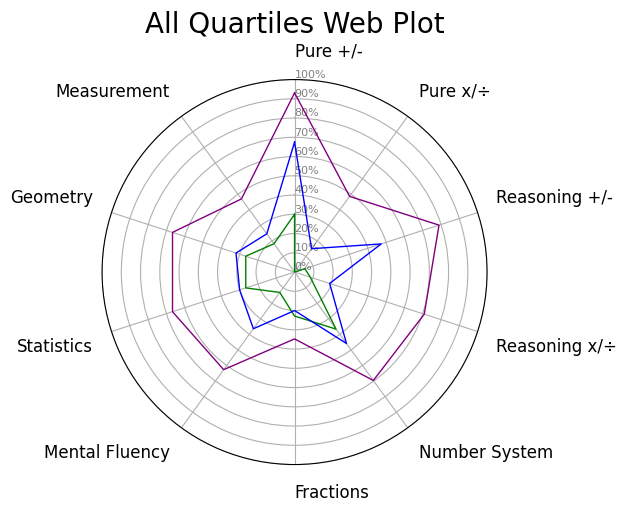
Rather than simply providing an overall score or identifying poorly answered questions, Dovepoint’s analysis highlights the underlying skills that are strengths or weaknesses.
The results are presented in an accessible graphical format, making it easy to see patterns across individual pupils, groups, classes and cohorts.
3) Understand
See where the gaps really are
The analysis helps answer some of the questions that a simple test score can’t:
- Which mathematical skills are secure?
- Which areas need further development?
- Are there common gaps across a class or cohort?
- Which pupils need additional support?
- Are there particular groups requiring intervention?
- Are there areas of the curriculum that need to be revisited?
This gives teachers and leaders a clearer picture of what pupils need to learn next.
4) Act
Use the information to target teaching
The purpose of diagnostic assessment isn’t simply to produce another report. It’s to help schools decide what to do with the information.
Dovepoint results can be used to inform:
- Whole-class teaching – identify areas that need further coverage across the class or year group.
- Small-group intervention – identify groups of pupils with similar needs and target support accordingly.
- Individual support – use individual skills profiles to identify specific areas for development.
- Curriculum planning – use cohort-level patterns to identify areas where teaching or curriculum coverage may need to be revisited.
One school used Dovepoint data to identify weaknesses in fractions, then targeted starters, interventions and subsequent teaching towards those skills. Six months later, fractions had become one of the cohort’s strongest areas.
5) Reassess
Measure the impact
When the assessment is repeated, schools can compare skills profiles and see whether areas previously identified as weaknesses have improved.
This creates a simple cycle:
Assess > Identify > Target > Reassess
Rather than assessment being a one-off snapshot, it becomes part of an ongoing process of improving pupils’ mathematical understanding.
For teachers, school leaders and MATs
The difference Dovepoint makes
Make your maths assessments work harder
See how Dovepoint can help your school move from assessment data to clear, targeted action.
Get in touch or email us at [email protected]